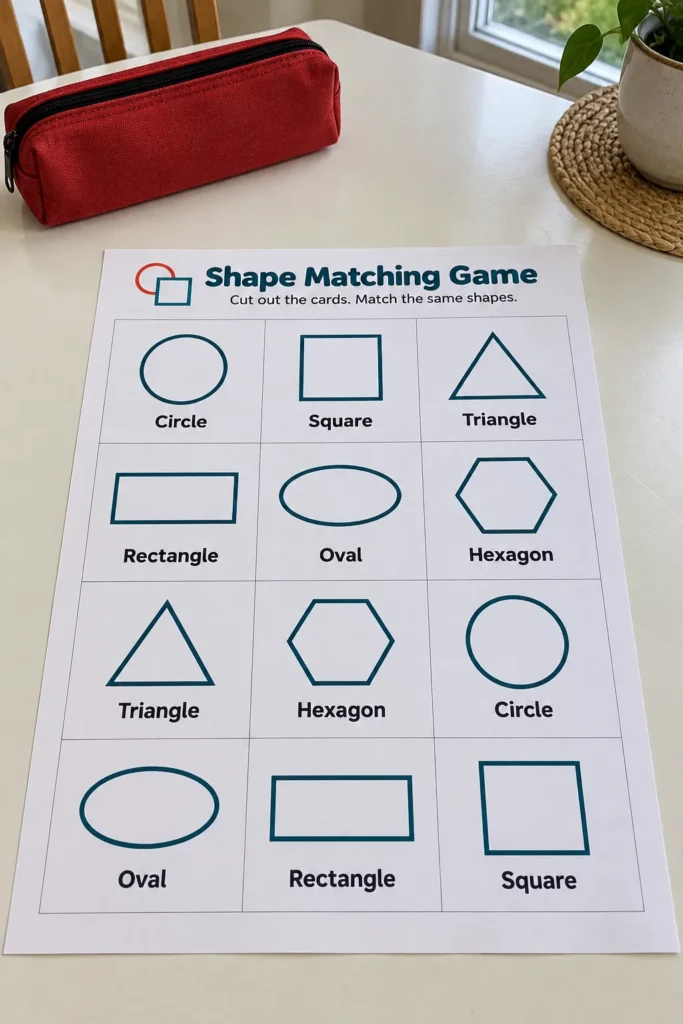
A child can match two red cards without noticing that one shows a triangle and the other shows a circle. Removing that color clue puts the attention on the outline itself. This activity uses the same outline color for every shape, giving you a clearer way to talk about curves, sides and corners.
The sheet contains two copies each of a circle, square, triangle, rectangle, oval and hexagon. Cut it into twelve cards for matching and sorting, or use a smaller selection for a child who is just beginning. The printed names are there for shared conversation rather than a reading requirement.
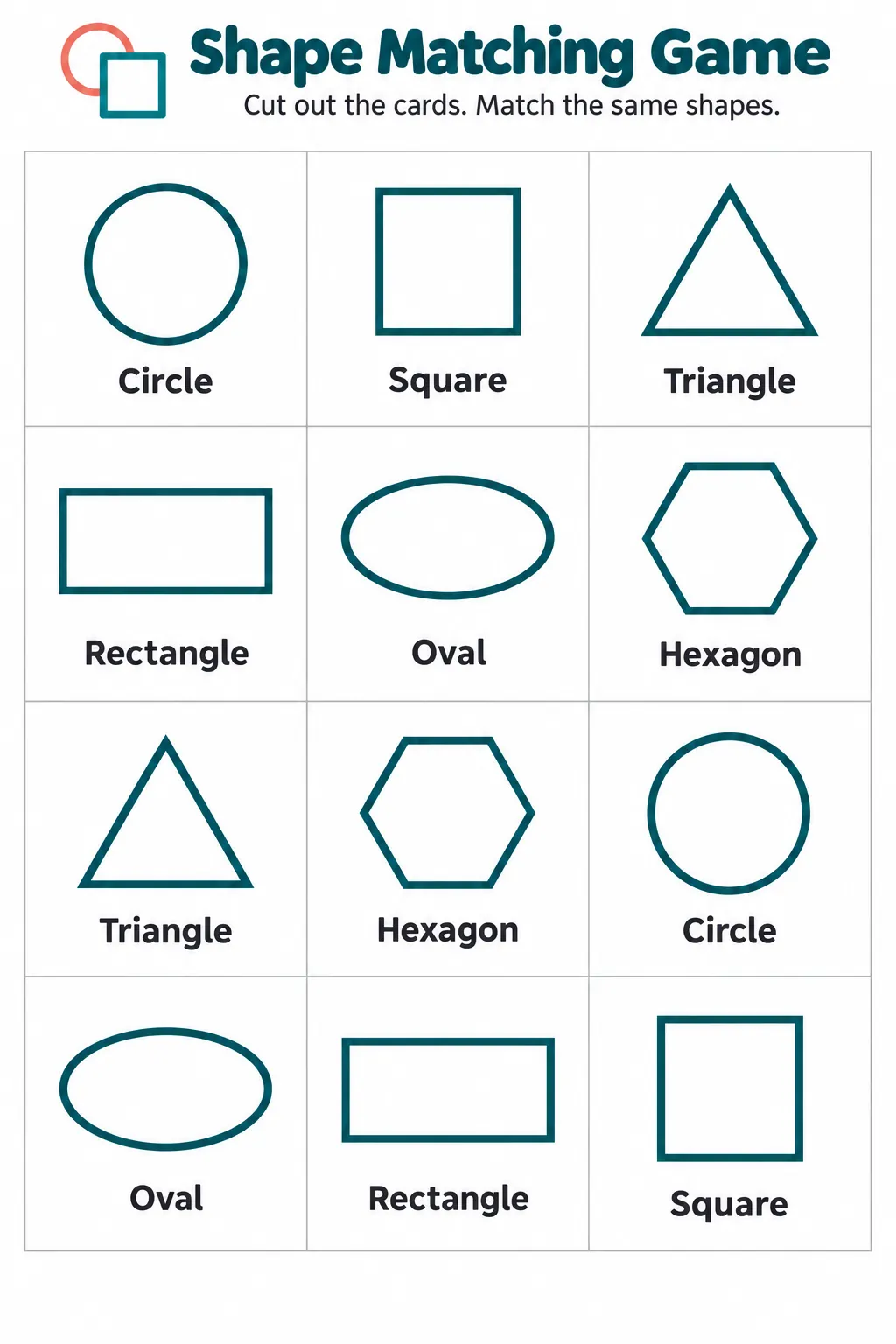
Download high-resolution printable
Open the preview for the full size image, or choose the download button to open it in a new tab. Save that image to your device, then print it in portrait orientation. Choose a fit to page setting on Letter or A4 paper and confirm that all outside card borders appear in the print preview.
Prepare a set with clear shape outlines
Ordinary white paper is enough for a first matching session. An adult can cut along the thin card boundaries and place the pieces on a plain surface with good contrast. Keep the shapes themselves intact; the rectangular card edges are cutting guides, not the outlines children are matching.
Use opaque paper or cardstock if you plan to turn the cards over later. Check that both copies of a shape have been cut to the same card size, because uneven backs can reveal a pair. Store all twelve pieces in an envelope after play so the next activity starts with a complete deck.
Match by looking before naming
Place the circle, square and triangle in front of your child, then offer their three partners one at a time. Ask where each card belongs and let the child compare the visible outlines. A correct placement counts as a picture match even if the child cannot yet say the shape name. Name it naturally after the match instead of turning every turn into a quiz.
Compare the shapes that look similar
Bring the square and rectangle together when those basic matches feel familiar. Both have four straight sides and four square corners, but the rectangle on this sheet has two longer sides and two shorter sides, while the square has four equal sides. Trace the edges slowly with a finger and compare the cards side by side.
The circle and oval offer a different comparison because both have curved outlines without corners. The oval on this sheet is stretched wider, while the circle is equally wide and tall. For the triangle and hexagon, touch each corner once as you count three or six. Keep the conversation about the printed examples rather than promising that one sheet teaches every variation of a shape.
Use sorting or memory as a next step
For shape sorting, separate curved outlines from shapes made only of straight sides. Circle and oval belong in the curved group, while square, triangle, rectangle and hexagon belong in the straight sided group. Another option is to collect all cards with four corners, which gives you both square cards and both rectangle cards.
For memory play, shuffle two or three pairs and lay them picture side down. Take turns turning over two cards, keeping a matching pair and returning different shapes to the same places. Add more pairs only when the smaller layout is comfortable, and stop while the child still wants to play.
Check the matches without making it a test
The pair key is circle with circle, square with square, triangle with triangle, rectangle with rectangle, oval with oval and hexagon with hexagon. Every shape appears exactly twice, so the full activity ends with six pairs. If a match is uncertain, place the two outlines next to each other and compare their edges instead of asking for a faster answer.
You can later look for similar shapes in a book cover, a plate or a window, while explaining that real objects may only resemble the printed outline. These small conversations connect preschool shapes with everyday objects without requiring another worksheet. A few attentive comparisons are more useful than finishing every card when your child has lost interest.