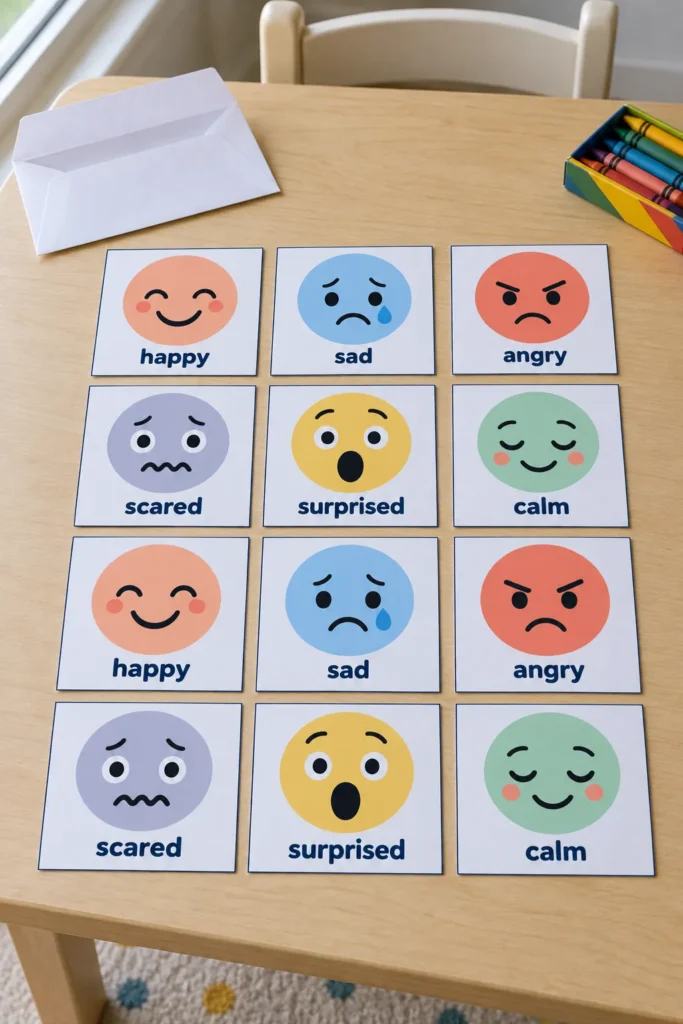
A child can match two smiling faces before they can explain a feeling. Start with pictures, name what you notice, and leave room for the child to disagree. This activity gives adults a simple way to practise feelings vocabulary without turning personal emotions into a test.
Save the matching cards
The page below contains twelve cards: two each for happy, sad, angry, scared, surprised, and calm. It is designed for preschool children with an adult reading the labels. Matching identical pictures is the first task; talking about feelings is an optional next step.
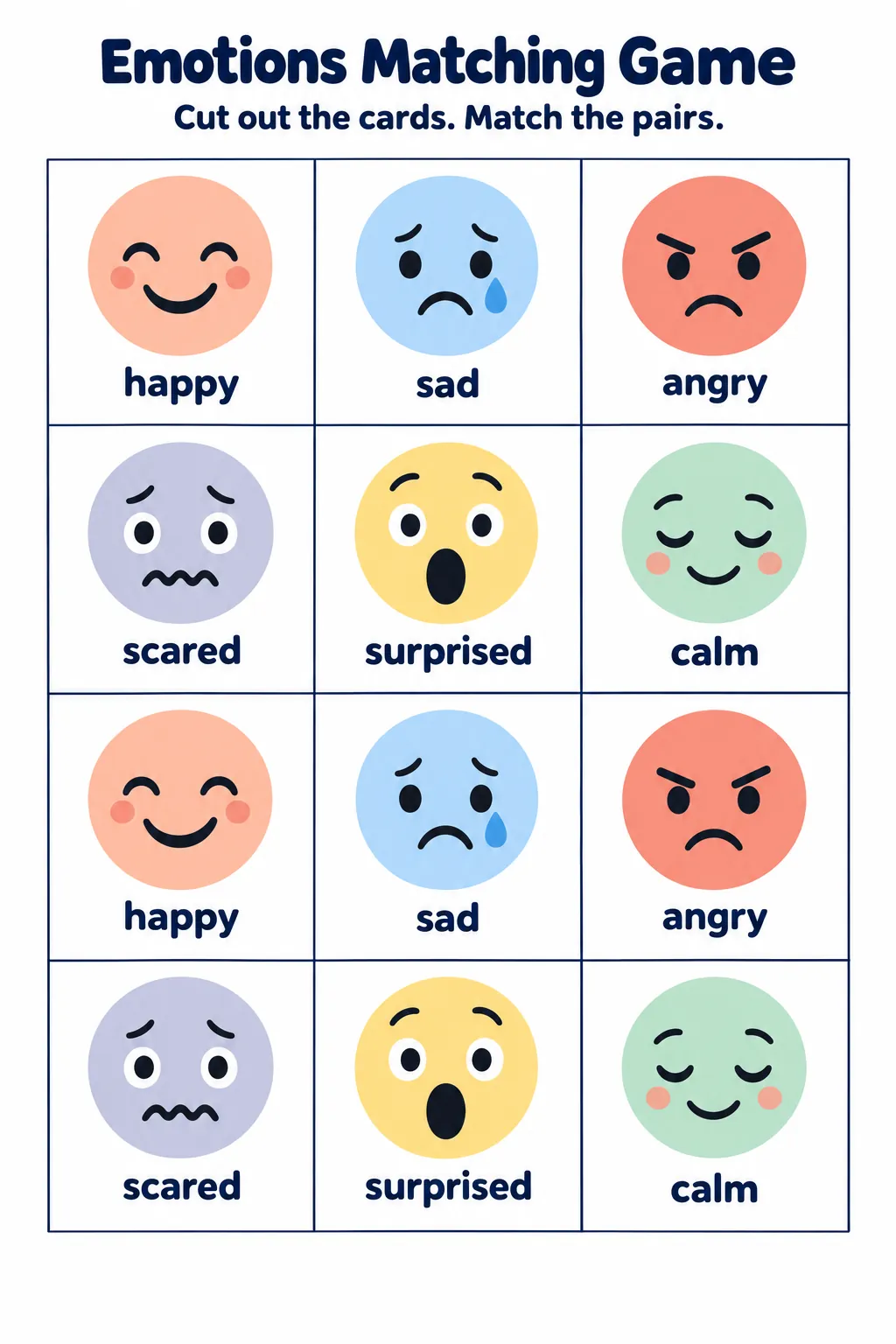
Download high-resolution printable
Use the download button to open the full size image in a new tab, then save it from there. Print one copy to get all six pairs. No separate answer sheet is needed because each label has one identical partner.
Prepare a small first round
Print on opaque paper or card so the pictures do not show through the backs. Choose a portrait page setting and fit the complete image within the printable area. Check a test copy before cutting, since printers can leave different margins.
An adult should cut along the card boundaries and keep every card the same size. Begin with just the two happy cards and two sad cards laid face up. Ask the child to find pictures that look the same, then say each feeling word together.
Turn picture matching into a memory game
Once the child understands pairs, mix those four cards and place them face down. Take turns turning over two cards, keeping a matching pair and returning different cards to their places. Continue until both pairs are found, without a timer or pressure to win.
Add another pair when the current set feels comfortable. With the full page, there are twelve cards and six pairs to find. For a cooperative version, collect all pairs together instead of counting each player’s score. These matching games for kids can stay short enough to finish while interest lasts.
Check every pair
The matching pairs are happy with happy, sad with sad, angry with angry, scared with scared, surprised with surprised, and calm with calm. Each word appears twice on the sheet. If a child pairs different expressions, compare the brows, eyes, and mouth before checking the labels.
Use the cards for gentle feelings conversations
Ask what the illustrated face might be feeling rather than declaring how a real person feels. A smile, tears, or wide eyes can mean different things in different situations. Listen if the child offers another explanation, and distinguish a picture match from a personal answer.
Try a simple prompt such as, “What could help someone who feels sad?” Offer a choice between sitting quietly together and asking for help if the child needs a starting point. Nobody has to share a private story or copy an expression to join in. The emotion picture cards support social emotional learning conversations, but they are not a diagnostic tool.
Adjust the activity to the child
Keep all cards face up for learners who are concentrating on picture matching or number of turns. An adult can read the labels aloud so reading skill does not become a barrier. For group play, place the cards where every child can see and reach them, and agree on a clear turn order.
Store the complete set in an envelope once play ends. Count twelve cards before putting it away so a missing partner does not frustrate the next round. On a difficult day, one face up pair and a quiet conversation may be enough.