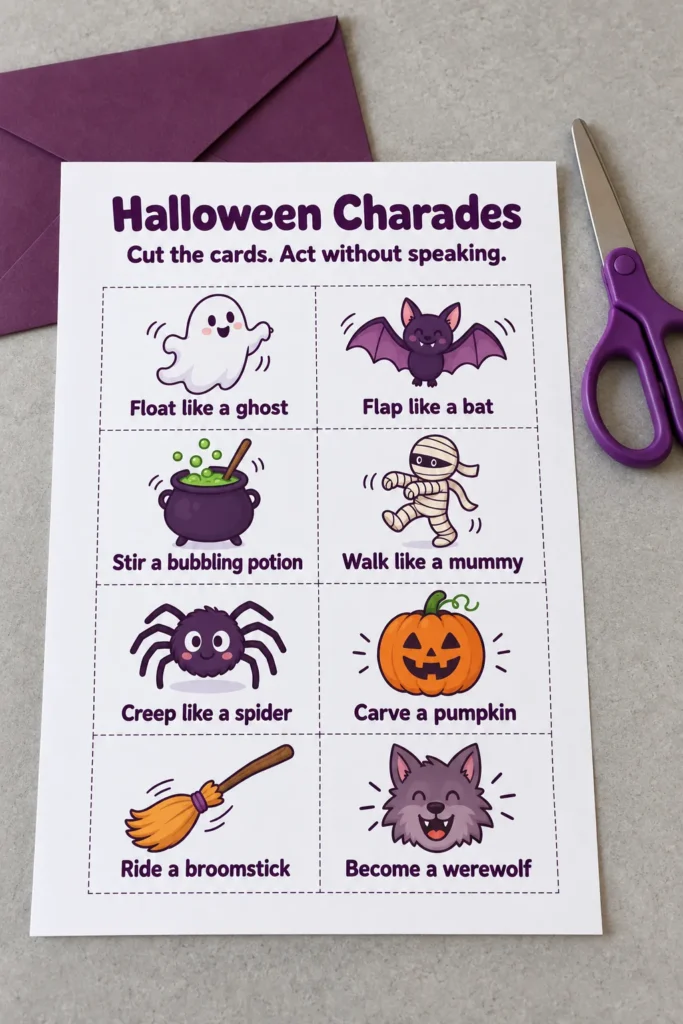
The hardest part of starting a guessing game is often thinking of something to act out while everyone waits. A small prepared deck removes that pause and gives children a clear action to try. Keep the mood playful, let anyone pass, and use pretend movements instead of props.
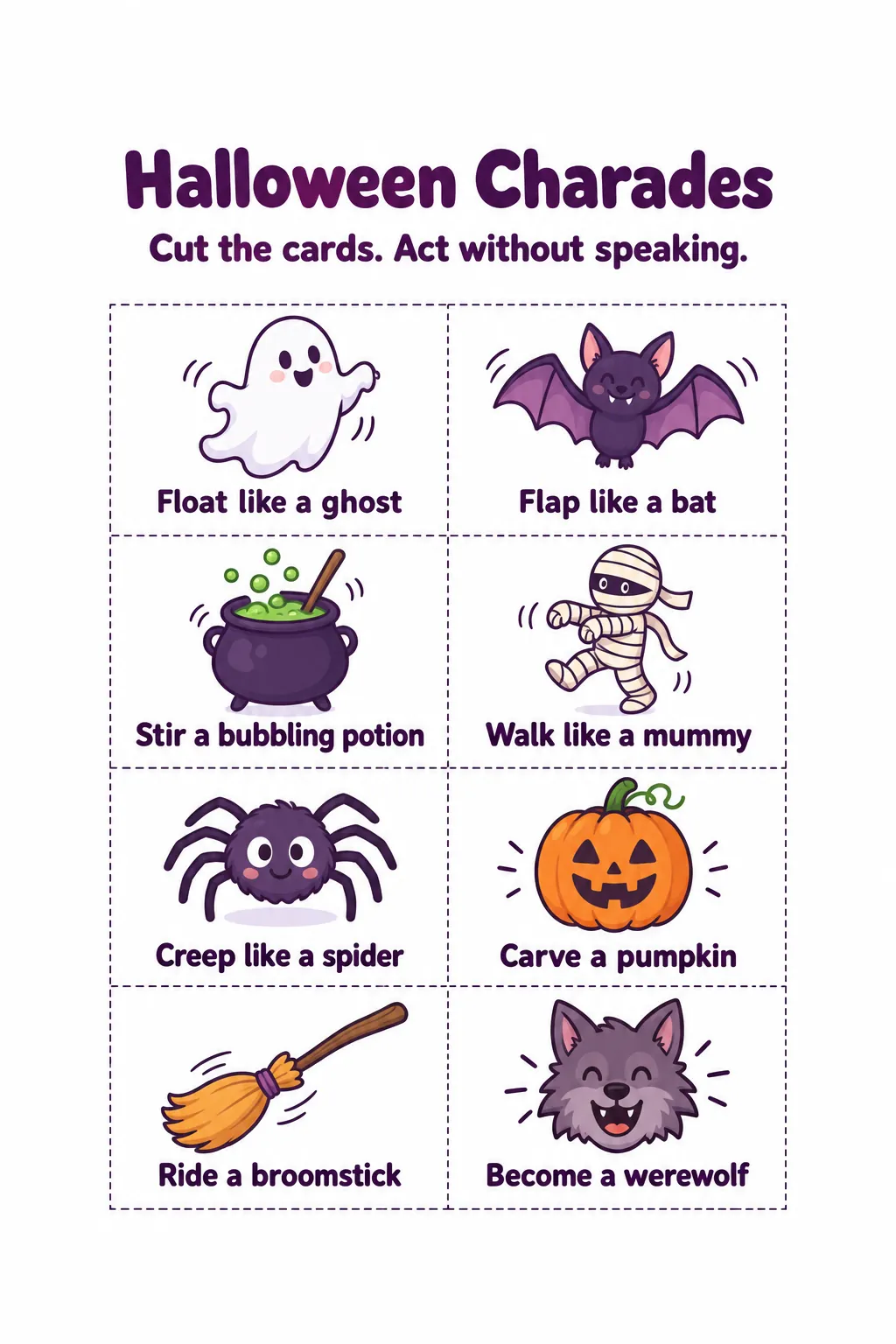
The sheet below contains eight different action cards for an adult led Halloween acting game. They suit primary age children who understand the idea of mime, with reading help for younger players. Friendly illustrations support the short prompts without turning the activity into a frightening performance.
Download high-resolution printable
Click the preview to open the full size image, or use the download button to open it in a new tab and save it from there. Print the whole image, then have an adult cut along the card boundaries. The download is a printable image file rather than a PDF.
Set up a small deck and a clear playing space
Shuffle the cut cards and place them face down. Choose a spot with enough space for comfortable arm movements and keep the floor free of objects that could trip a player. No costume, real broom, carving tool, or other physical prop is needed.
An adult can demonstrate one prompt before the first turn so everyone understands the game. Keep cards hidden from the guessers when they are drawn. If a child needs reading help, quietly read their prompt to them away from the other players.
Act without speaking or making sound effects
On a turn, one player draws a card and acts its idea silently while the others guess. Use facial expressions, hand movements, and posture, but do not say the words or make the creature sound. Put the card aside when the idea is guessed or the player chooses to stop.
For an informal family game, accept a clear matching answer such as “ghost” for Float like a ghost. You do not need to demand the exact printed sentence. Agree on how much detail counts before using a score, so younger players are not surprised by changing rules.
Choose movements that fit the prompt
Float like a ghost can use gentle drifting arms, while Flap like a bat uses wing shaped arm movements. Stir a bubbling potion suggests a large imaginary spoon, and Walk like a mummy can be shown with a slow stiff posture. Each action is pretend; nothing needs to be wrapped around a player.
Creep like a spider can be acted with fingers instead of crawling on the floor. Carve a pumpkin uses imaginary careful hand movements without a real blade, and Ride a broomstick can be mimed while staying in one spot. Become a werewolf might show changing posture and pretend claws, without growling or touching another person.
Give shy players a comfortable way to join
Let a player pass or choose another card without losing a point. A pair can act together if that feels easier, while another child can help shuffle or manage the used pile. Watching one round before joining is also a reasonable option.
For players with different movement needs, use seated gestures or upper body acting. Remove a prompt that is unfamiliar or uncomfortable instead of asking someone to explain why in front of the group. Kids Halloween charades works best when participation feels safe and voluntary.
Adjust the round for your group
Play cooperatively to guess the deck together, or split into two teams and alternate actors. If your group likes a timer, agree on a comfortable time before starting and give each team the same allowance. Skip timing for early readers or anyone who needs more thinking time.
This is a short eight card deck, so repeated rounds will become easier as players learn the prompts. Shuffle again for another turn or stop while people still want to play. For Halloween group games, an adult can lead a small station rather than expecting one deck to occupy a large party indefinitely.
Print the lettering clearly and keep the cards together
Use portrait orientation and fit the complete vertical 2:3 image inside the printable area. Extra white borders on letter or A4 paper are normal; avoid a setting that crops the title or outer cut lines. Print a full sheet so the card words stay readable, and use heavier paper only if your printer supports it.
The dark text and clear card boundaries remain useful in grayscale. Put the finished deck in an envelope and keep a spare printed sheet if pieces are easily lost. Before the next game, check that all eight prompts are present and that the space is ready for comfortable pretend movement.