
Wall Stickers vs Decals vs Murals: Key Differences
Wall stickers and wall decals are often two names for the same basic product: an adhesive-backed graphic applied to a wall. A wall mural is easier to distinguish because it creates one large scene or continuous design, usually from full-height panels. The label on the listing matters less than the format, material, adhesive, coverage, and installation method.
If you are comparing wall stickers vs wall decals or wall decals vs wall murals, start with the result you want. Choose small stickers for scattered accents, decals for shaped graphics or lettering, and a mural when the wall itself should become the image.
The quickest wall covering comparison
| Feature | Wall stickers | Wall decals | Wall murals |
|---|---|---|---|
| Typical format | Small peel-and-stick pieces | Cut shapes, lettering, or printed graphics | One large piece or aligned panels |
| Coverage | Scattered accents | Small to large focal graphic | Most or all of a wall |
| Installation | Usually easiest | Easy to moderate; transfer tape may be used | Most demanding; measuring and seam alignment matter |
| Best for | Quick themes, labels, small motifs | Quotes, silhouettes, logos, decorative clusters | Immersive scenes and full accent walls |
| Main risk | Looking scattered or toy-like | Alignment and fine-edge lifting | Panel drift, visible seams, bubbles, large removal area |
What counts as a wall sticker?
“Wall sticker” is the broadest and least technical term. It commonly describes small, ready-to-peel motifs printed or cut on individual liners: stars, dots, animals, flowers, sports shapes, labels, and simple wall art stickers. They may be made from vinyl, polyester fabric, paper, or another film.
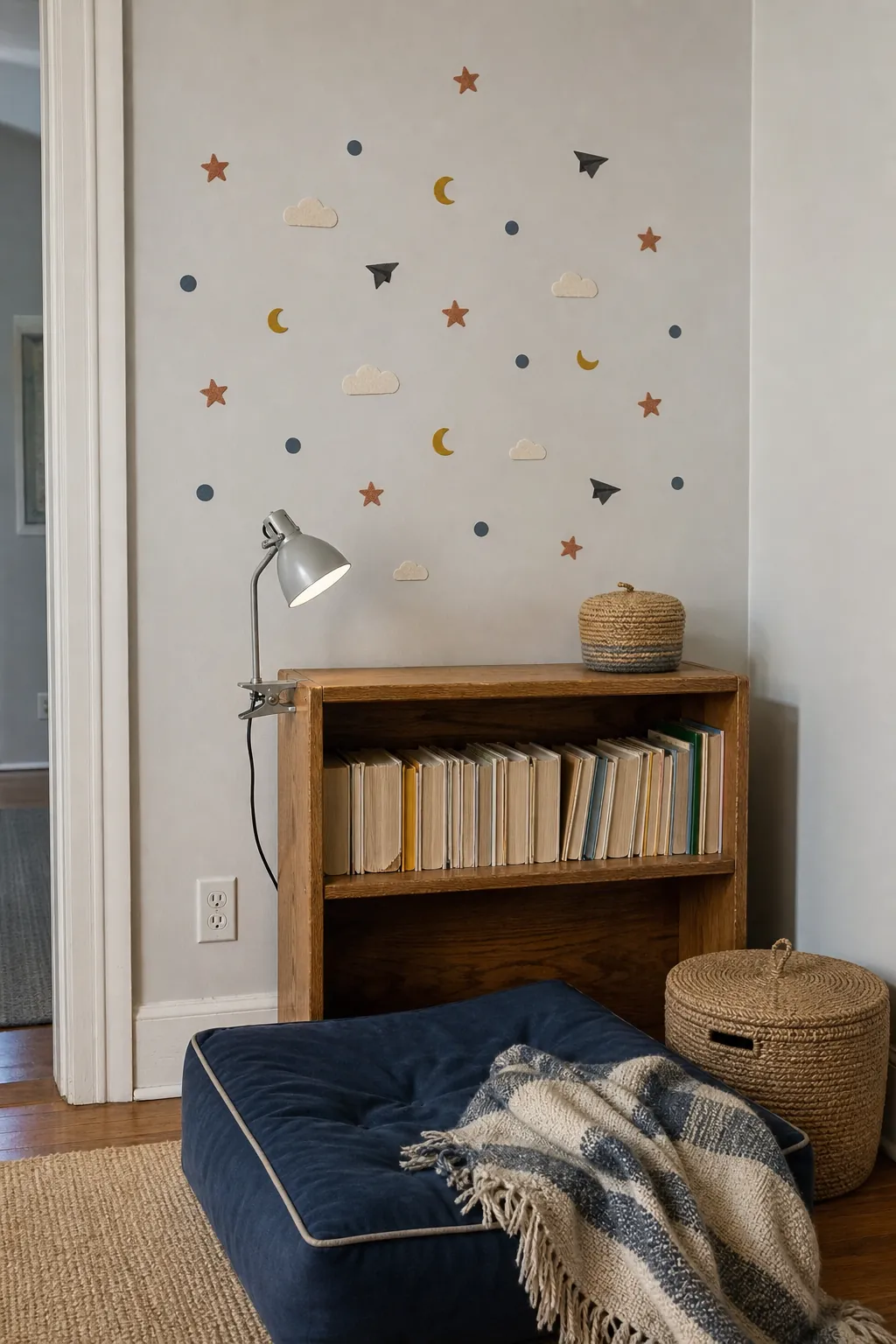
Small stickers are forgiving because each piece can be positioned independently. A crooked star does not ruin an entire composition. They suit small rooms, dorms, play areas, rented bedrooms, and anyone who wants a light accent rather than a dominant feature wall. The limitation is visual cohesion: too many unrelated pieces can feel busy, and tiny edges create many opportunities for lifting.
What counts as a wall decal?
A wall decal usually implies a more intentional graphic. It may be a die-cut silhouette, coordinated botanical cluster, growth chart, name, quote, office logo, or large printed motif. Detailed vinyl designs often use transfer tape that holds separate pieces in alignment while they move from liner to wall.

Large wall stickers and decals overlap heavily in shops. A seller may call a 120-centimeter tree a sticker while another calls the same construction a decal. Instead of deciding by name, ask whether it is one piece or a set, whether it uses transfer tape, whether the graphic has a clear background, whether it is removable or repositionable, and what surfaces the adhesive supports.
What makes a wall mural different?
A wall mural treats the wall as a canvas. The image may be a forest, oversized floral study, abstract color field, city map, photograph, or custom artwork. Most murals arrive as vertical panels that align edge-to-edge or with a specified overlap. Smaller murals may arrive as one large sheet.

A peel and stick mural has adhesive already applied. Other murals use paste, arrive prepasted, or use a removable textile system. “Mural” describes the visual scale, not one universal material. A removable wall mural can still require careful wall preparation, two-person handling, accurate panel order, a plumb starting line, trimming, and patient smoothing.
Coverage changes the visual effect
Stickers add rhythm. Decals create a focal point. Murals create an environment. That difference affects everything around them. A scatter of small stars leaves paint as the dominant background. A floral decal interacts with the bed or desk below it. A wall mural controls the room’s palette and can make furniture read as foreground against a continuous scene.

Use the smallest format that delivers the effect you want. A mural is unnecessary when a cluster of decals can define a reading nook. A handful of stickers will not create the visual depth of a full botanical or architectural scene.
Installation difficulty rises with size
Small stickers usually need only clean hands, a planned layout, and firm pressure. Decals may require measuring, temporary alignment marks, a level, and a felt-covered squeegee. Transfer-tape designs must be burnished carefully so narrow pieces release from the carrier and stay on the wall.
Murals add panel order, plumb alignment, ceiling and baseboard trimming, seam matching, switch plates, corners, and cumulative error. The first mural panel must be straight; room corners often are not. A small tilt in the first panel becomes a large mismatch several panels later.
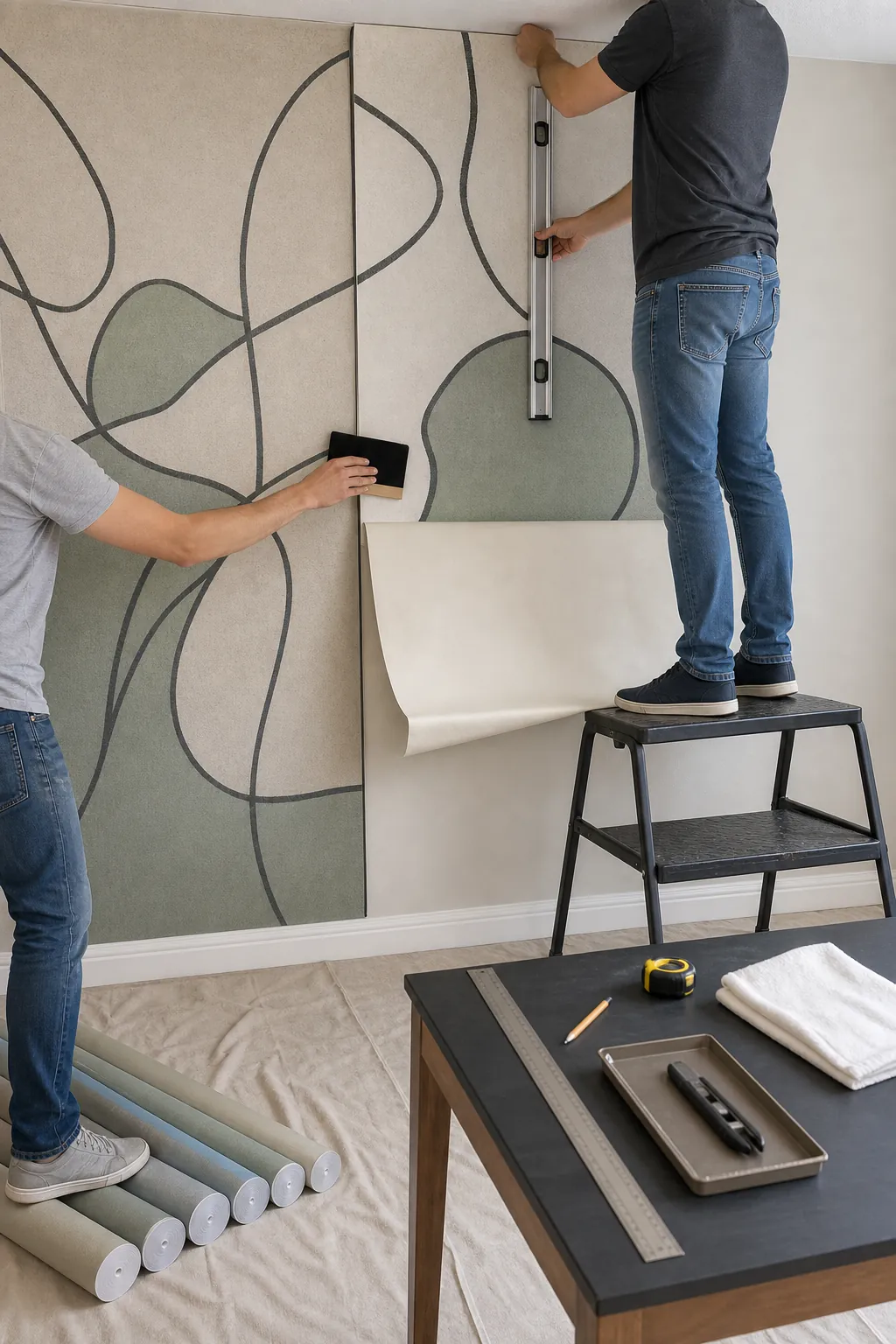
For a peel-and-stick mural, lay panels out in order, establish a true vertical guide, expose only a short section of backing at a time, and smooth from the center outward. Do not stretch a panel to force pattern alignment. Follow the maker’s seam method because butt seams and overlaps are not interchangeable.
Surface problems grow with coverage
All three formats prefer a clean, dry, smooth, sound, fully cured surface. Texture reduces adhesive contact. Dust and grease create weak areas. Flat, stain-resistant, scrub-resistant, low-VOC, and specialty paints can behave unpredictably with some adhesives.
A failed sticker affects a few square centimeters. A failed mural can lift along several seams or remove paint across a large wall. The larger the project, the more valuable a sample and dwell test becomes. Order the actual material, test it on the exact wall, and ask how long it should remain before removal.
Removal and reuse are separate claims
Removable means the adhesive is intended to release under specified conditions. Repositionable means the piece can be lifted and adjusted during installation. Reusable means it can survive removal, storage, and reapplication. A product may offer one benefit without the others.
Small fabric stickers may be easy to store on their liners. Thin vinyl lettering often stretches or loses alignment during removal. A mural panel is difficult to handle without folding or contaminating adhesive, even when the material is technically reusable. Judge reuse at the size you are buying, not from a claim based on a tiny sample.
Which should you choose?
- Choose wall stickers for small scattered motifs, quick themes, low-cost experiments, and easy one-piece-at-a-time placement.
- Choose wall decals for a defined focal graphic, precise lettering, coordinated shapes, logos, growth charts, and wall graphics for home that should not cover the full wall.
- Choose a wall mural for an immersive accent wall, one continuous artwork, custom photographic scale, or a design that must transform the room’s entire visual field.

Before ordering, confirm exact dimensions, panel count, material, adhesive type, finish, approved surfaces, fresh-paint cure time, expected indoor life, seam method, removal instructions, and whether samples are available. That specification tells you far more than whether a retailer uses the word sticker or decal.
A name cannot make the wall compatible
The practical hierarchy is simple: stickers are individual accents, decals are defined graphics, and murals cover enough area to become the wall’s main image. Retail language will continue to blur the first two. Buy by construction and coverage, test by surface, and plan installation by scale. Those three choices prevent more regret than any product-category label.